
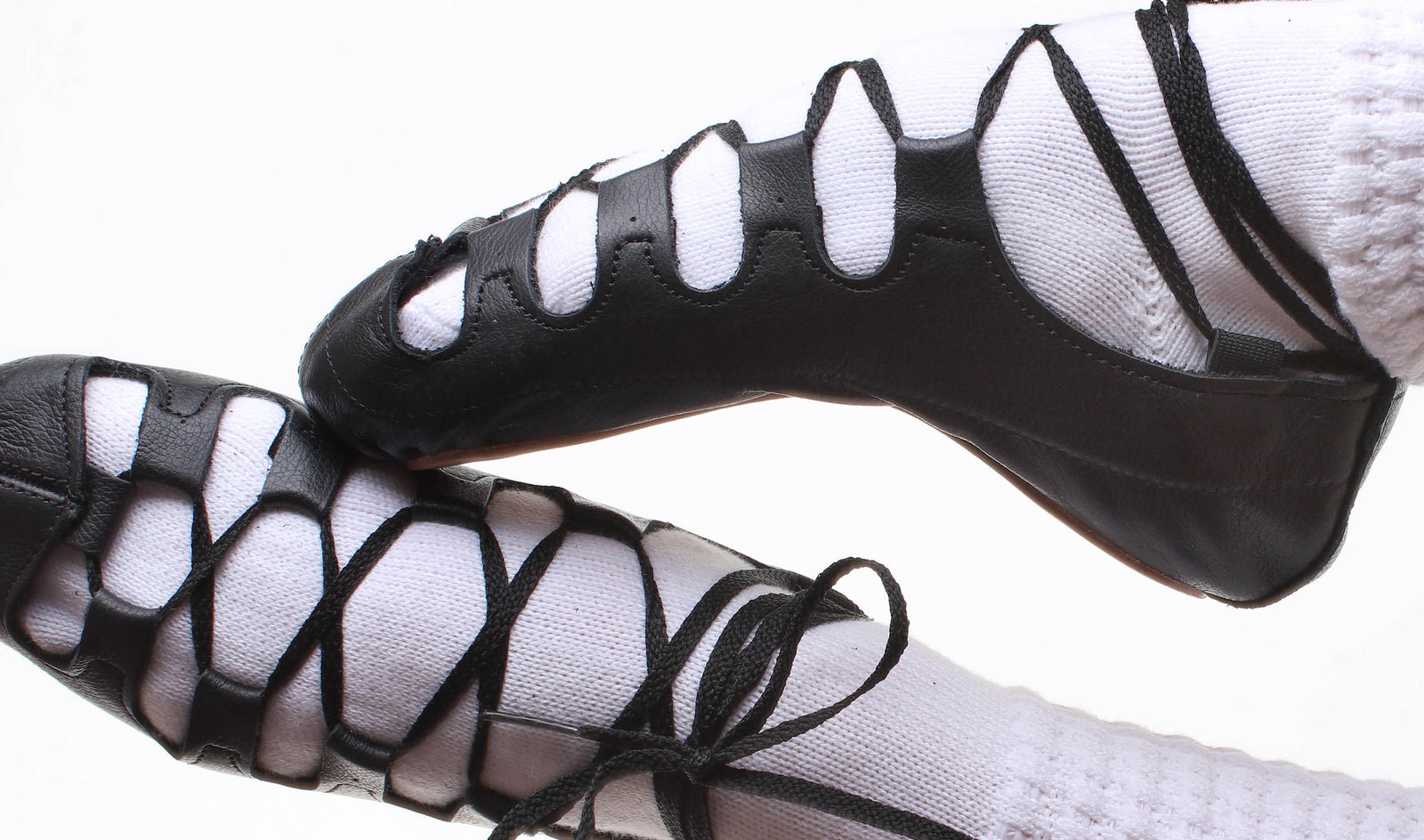
The Irish dance notebook
Little loops. Neat laces. Ready for the first reel.
New Irish dance pumps have arrived, the dance bag is packed… and then you meet the laces. All those little leather loops can look puzzling the first time, especially when you are helping a young dancer get ready for class.
Learning how to tie Irish dance pumps becomes much easier when you separate the job into two parts: threading the lace through the correct loops, then adjusting and tying the shoe on the foot. This guide takes you through both, with a new diagram and the original close-up photographs.
Adapted from Dance World’s original guide by Stephen Rock, with updated lacing notes and a new visual guide.
The quick answer
How do you lace and tie Irish dance pumps?
For the traditional single-side-loop pump shown here, centre the lace through the toe loop, take each end through the first loop on the same side, then criss-cross through the remaining front loops. Cross into the side loops, pass through the heel loop and bring the ends forwards. Adjust evenly on the foot, tie a bow, double-knot it and secure any long ends.
Before you begin
First, check which Irish dance pumps you have
This tutorial follows the traditional single-side-loop layout in the photographs below. “Single side loop” means one additional loop on each side near the ankle, beyond the loops across the front of the shoe.
The number and position of loops can vary. Some pumps have extra arch eyelets or a different heel arrangement, so the same route will not suit every pair. Antonio Pacelli, for example, provides separate lacing demonstrations for its traditional Essential/Gazelle pumps and its arch-eyelet styles.

How to lace Irish dance pumps: the visual guide
The two colours show the two halves of one continuous lace. Start at the toe, work towards the heel, then bring the ends forwards to tie. The photographs and detailed instructions below show the individual stages.
How to tie beginner Irish dance pumps, step by step
If you are starting with an unlaced shoe, it is usually easier to thread it off the foot. Keep the lacing loose enough to put the pump on afterwards, then make your final adjustments while wearing your usual dance socks.
1. Centre the lace through the toe loop
Find the small loop at the very front of the pump. Pass the lace through it and pull until the two free ends are approximately the same length.
This gives you a balanced starting point. If one end is much shorter, correct it now; it becomes harder to even out once the rest of the shoe is threaded.
2. Go straight to the first loops
Take each end through the first front loop on the same side of the shoe. At this first stage, do not cross the ends over the middle.
That small straight section is easy to miss. The first photograph below shows the starting route, followed by the beginning of the crossing pattern.

3. Criss-cross through the front loops
Bring the right-hand end across to the next loop on the left. Bring the left-hand end across to the next loop on the right.
Continue upwards through the remaining front loops, creating a series of X shapes. Keep the lace lying smoothly, and leave enough slack for the foot rather than pulling each crossing tight as you thread.
4. Use the side loops, then the heel loop
After the final front loops, cross the ends again and pass each one through the side loop on the opposite side near the ankle.
Guide both ends around towards the back of the shoe and pass them through the heel loop from opposite directions. Bring them forwards again, ready to tie. Check the side and rear views in the photograph below before tightening.

5. Settle the foot, adjust and tie
Put on the pump with your usual class socks. Settle the heel fully into the back and check that the leather sits smoothly around the foot.
- Work from the toe upwards, taking up slack a little at a time.
- Adjust the side and heel sections so the shoe feels evenly held.
- Bring the ends together at the front of the ankle and tie a normal shoelace bow.
- Double-knot the bow, then secure any long loops or tails beneath the lacing as your teacher recommends.
Leave a compact finish with nothing trailing towards the floor. Check both shoes before dancing.

How tight should Irish dance pump laces be?
The shoe should feel close and secure, with the heel properly seated and pressure spread evenly across the foot. Aim for a comfortable hold rather than pulling the lace ends as hard as possible.
Gently point and flex the foot, then try a few familiar steps under your teacher’s guidance. Check for heel movement, pressure across the top of the foot or a bow that starts to loosen.
If the laces pinch or cause tingling or numbness, stop and loosen them. If the shoe still slips or feels uncomfortable after the lacing is adjusted, ask your teacher or fitter to check its size, shape and condition.
The quick check before class
- The heel sits fully inside the pump.
- The socks lie smoothly without bunching.
- Lace tension feels even from toe to ankle.
- The bow is double-knotted and secure.
- No long loops or ends trail loose.
- Pointing and flexing feel comfortable.
Common Irish dance pump lacing problems
A small adjustment can make the routine easier. Start with the part that feels wrong, then check the whole shoe again.
The heel slips
Check that the heel is seated and the side and heel loops are threaded correctly. Persistent slipping needs a fit check.
The top feels tight
Loosen the crossings and redistribute the tension from the toe upwards. One overtight section can remain uncomfortable even with a loose bow.
One tail is too short
Check that the lace is centred at the toe and follows the same route on both sides. Work slack back through the loops before retying.
The bow comes loose
Retie a compact bow, double-knot it and secure the ends. Replace frayed or damaged laces before the next class.
Useful essentials for Irish dance pumps
A spare pair of Antonio Pacelli round pump laces is a practical addition to the dance bag. Choose a suitable length for the shoe size and lacing route, and follow your school’s preference for lace colour.
Shopping for a first pair? The Goleen Aisling GL32 beginner pumps are one full-sole option to discuss with your teacher. Compare the actual loop layout before applying any tutorial, as models can differ.
For socks, use the style your school recommends when checking shoe fit. Our dance socks guide includes an explanation of Irish dance poodle socks and their different lengths.
Irish dance pump lacing: your questions answered
Are Irish dance pumps and ghillies the same thing?
In Irish dance, pumps and ghillies commonly refer to the same lace-up soft shoes, also called light shoes. This guide covers that style, rather than hard jig shoes or boys’ heeled reel shoes.
Do I cross the laces straight after the toe loop?
For the pump shown here, take each end to the first loop on the same side before starting the criss-cross pattern. If your shoe has a different layout, use the maker’s instructions.
Do all Irish dance pumps lace up the same way?
No. Traditional beginner pumps and shoes with extra arch eyelets can use different routes. Check the number and position of the loops, then ask your teacher or fitter if you are unsure which method applies.
Should I wrap extra lace around my ankle?
Follow the intended side-and-heel route for your shoe. Avoid adding tight wraps simply to use up spare length. Tie securely, contain the loose ends and ask your teacher whether a different lace length would work better.
Should I cut Irish dance pump laces shorter?
Check the completed route and bow on the foot before considering a trim. Once cut, a lace may be too short or lose its easy-threading tip. A suitable replacement length is often simpler; ask your teacher before cutting.
Do I need to unlace my pumps completely after every class?
Usually, you can undo the bow and loosen the upper sections enough to remove the shoe comfortably. Keep the established route in place, and avoid forcing your foot out while the laces are still tight.
Ready for the next reel?
A little practice makes lacing part of the routine. Explore our Irish dancing shoes and accessories for beginner pumps, replacement laces and the essentials for class.
Explore Irish dancing shoes & essentials